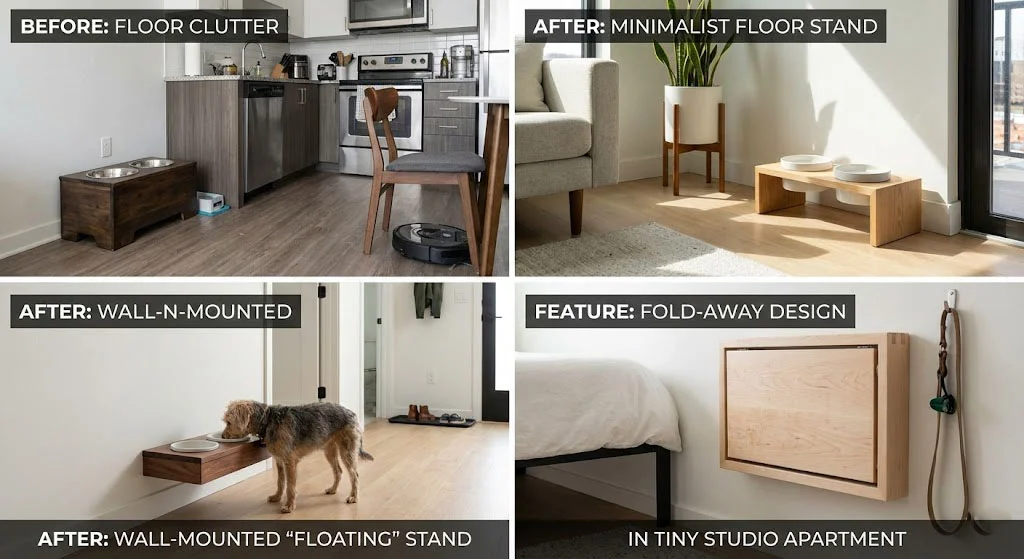
In the dense urban landscape of 2026, the “American Dream” has shifted. For many, it no longer means a sprawling suburban lawn but a sleek, high-efficiency studio in a vertical forest or a reclaimed industrial loft. As our living quarters have become more intentional, so has our approach to pet care.
For the modern “Pet Parent,” the floor is precious real estate. Every square inch counts. This has led to the rise of the most significant trend in pet furniture this decade: The Wall-Mounted Wooden Dog Stand. It’s not just a bowl holder; it’s a spatial revolution that marries the principles of Japanese minimalism with the warmth of mid-century craftsmanship.
The Vertical Shift: Why Floors are for Paws, Not Bowls
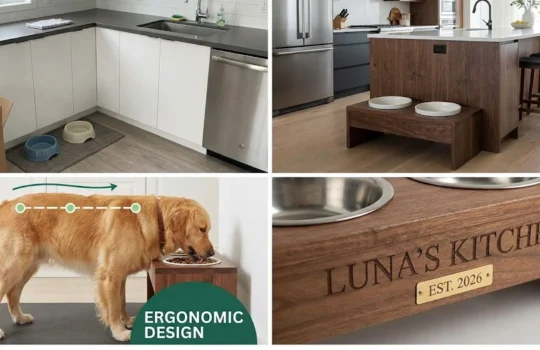
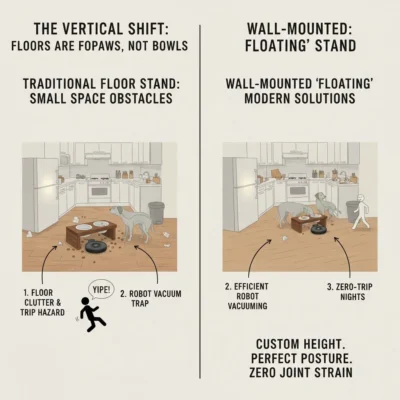
In a 500-square-foot apartment, a traditional floor-based dog feeder is a bulky obstacle. It collects dust bunnies, creates a trip hazard in the dark, and—worst of all—acts as a fortress of solitude for your robot vacuum to get stuck on.
Wall-mounted (floating) stands solve these issues by utilizing the “dead space” of your walls. By lifting the feeding station off the ground, you achieve:
Visual Breathability: Seeing more of your floor makes a small room feel significantly larger.
Cleaning Efficiency: Your Roomba can glide effortlessly underneath, ensuring no kibble-crumbs are left to haunt your hardwood.
A Zero-Trip Zone: No more stubbing your toe on a heavy wooden block during your 2 AM trip to the kitchen.
Ergonomics Without Compromise
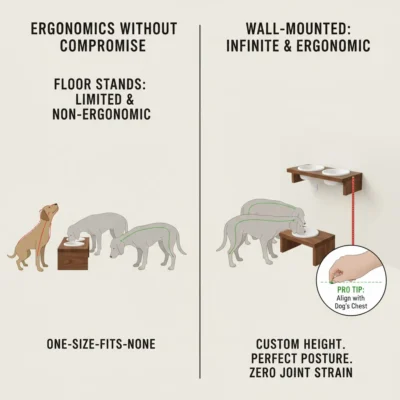
The most significant functional advantage of a wall-mounted wood stand is infinite adjustability.
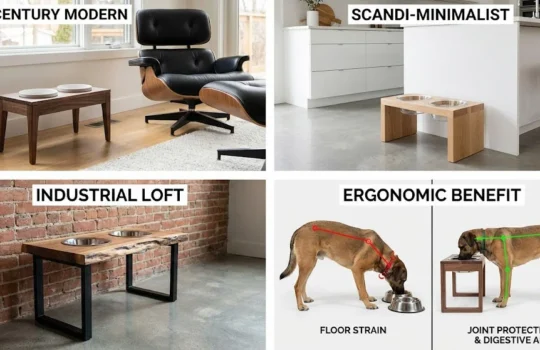
Every dog’s “perfect height” is unique. A floor stand comes in three sizes: Small, Medium, and Large. But what if your dog is a “Medium-and-a-half”? With a wall-mounted system, you aren’t limited by the manufacturer’s legs. You can mount the station at the exact millimeter that aligns with your dog’s chest, promoting optimal digestive health and reducing long-term joint strain.
The 2026 Pro Tip: To find the perfect height, measure from the floor to the point where your dog’s front legs meet their chest. That should be the top edge of your floating stand.
Material Choice: The Weight-to-Strength Ratio
When you are hanging a feeder on a wall, material science matters more than ever. You need a wood that is light enough not to rip the anchors out of the drywall, yet strong enough to withstand the “enthusiasm” of a hungry 80-pound Golden Retriever.
The Top 3 Woods for Floating Stands:
American White Oak: Known for its incredible structural integrity and beautiful, tight grain. It matches almost any modern “Scandi” or “Japandi” interior.
Black Walnut: The king of “Quiet Luxury.” Its deep tones provide a stunning contrast against white or light-gray walls.
Hard Maple: Exceptionally dense and heavy-duty. If you have a “power eater” who tends to lean on their stand, Maple is your best friend.
Design Styles: Minimalist But Meaningful
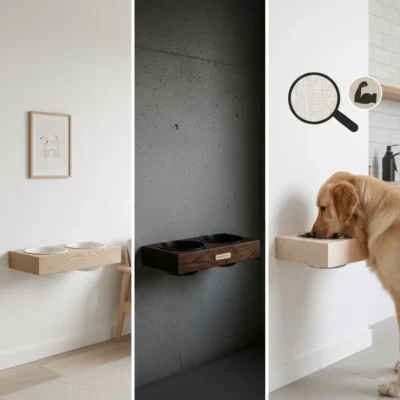
Minimalism in 2026 isn’t about “boring”; it’s about intentionality. Here are the three design profiles currently dominating the US small-space market:
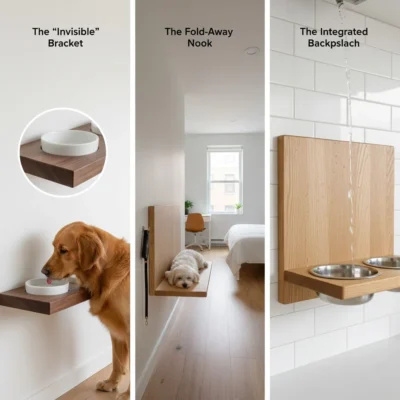
- The “Invisible” Bracket: This design uses hidden steel hardware that slides into the back of a thick wood slab. The result? A piece of Walnut that looks like it is magically hovering. It’s the ultimate choice for those who want a “gallery” look in their home.
- The Fold-Away Nook: Perfect for the ultra-tiny home. These stands feature a high-quality hinge system that allows the wooden platform to fold flat against the wall when not in use. It’s functional art at its finest.
- The Integrated Backsplash: Since the bowls are now closer to your walls, “splash protection” is key. Modern designs often include a matching wooden vertical plate that protects your paint or wallpaper from water droplets and drool.
The Technical Side: Installation Secrets
A wall-mounted stand is only as good as its installation. To ensure your “furniture-grade” investment doesn’t become a floor-bound disaster, follow the “Stud-First” rule.
Locate the Studs: Always try to screw at least one side of the bracket into a wooden wall stud.
Heavy-Duty Anchors: If a stud isn’t available exactly where you want it, use toggle bolts rather than plastic screw anchors. Toggle bolts can hold up to 100+ lbs, providing the security needed for a dog that likes to “push” their food.
Waterproofing the Wall: If your dog is a messy drinker, apply a small, clear bead of silicone between the back of the wood stand and the wall to prevent moisture from seeping behind the furniture.

The 2026 Aesthetic: “Japandi” for Dogs
The most popular small-space aesthetic this year is Japandi—a fusion of Japanese functionalism and Scandinavian rustic warmth. A floating wood stand fits this perfectly.
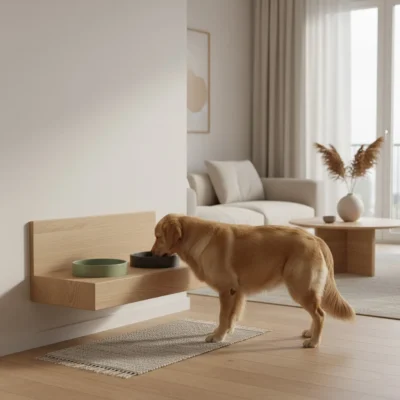
Pair your light Oak stand with matte-ceramic bowls in “Earth Tones” like Sage Green, Terracotta, or Charcoal. This combination removes the “industrial” feel of traditional pet products and turns the feeding area into a spa-like retreat for your pet.
Elevating the Standard
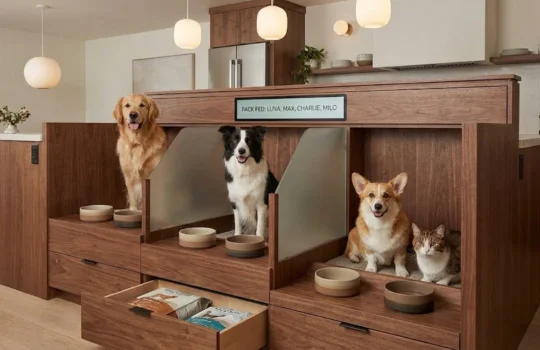
Choosing a wall-mounted wooden dog stand is more than a space-saving hack; it’s a commitment to a cleaner, more organized, and more ergonomic lifestyle. In the small-space living of 2026, we don’t just “fit” our pets into our lives; we design our lives around the shared harmony of the “pack.”
Lift the bowl. Clear the floor. Breathe easier.